
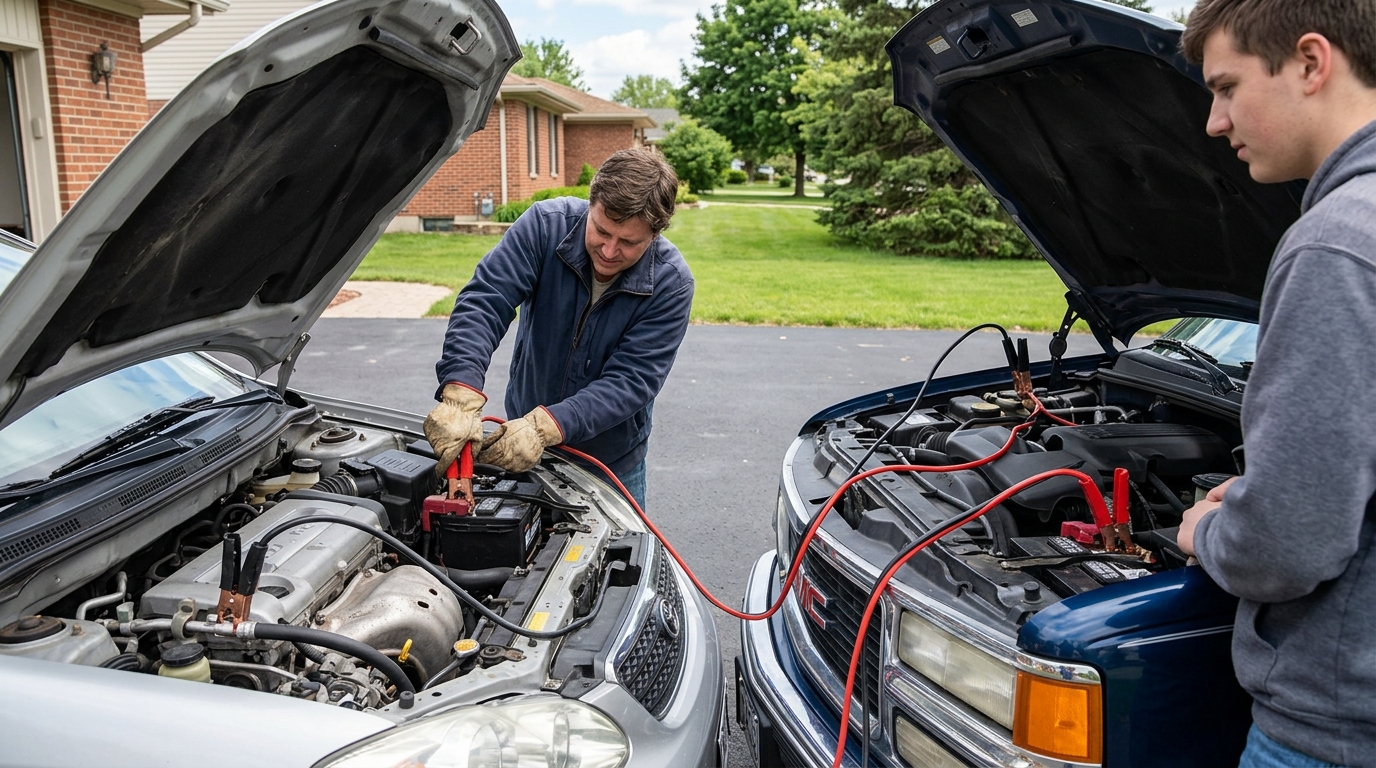
Jumping a Car can Cause a Lot of Damage if You Aren’t Careful
If a vehicle has a dead battery the ideal thing to do is remove the battery and put it on a slow charger. This will avoid any voltage spikes that will damage delicate electronics. But if you have no other choice but to jump-start a vehicle there if a definite procedure and order of connecting the jumper cables. Here is the proper procedure for jump-starting a car.
Car batteries can lose their charge for more than a few reasons. Leaving the lights on has to be the number one reason. A dead battery is such an unexpected thing that most of us are caught unprepared. It’s times like these when many of us rely on the kindness of strangers to jump-start our cars, but sometimes you need to be the kindly stranger or at least the one who knows which cable goes where.
What you will need:
- A car with the same voltage battery as your own, fully charged
- A set of jumper cables
- A wire brush (optional)
- Safety glasses
- Rubber gloves (Optional)
Before you start:
When you’re stranded in the mall parking lot or on the side of the road asking passing motorists if they’ll give you a jump start for your car, you’ll find that there are two kinds of motorists: those who have jumper cables and those who don’t.
If you get your own set of jumper cables, and keep them in the car, you’ll increase your chances of getting a jump-start by about a billion percent. What you need to get is a good set of heavy gauge (4 to 8 gauge) copper jumper cables that are at least 10 feet long. They will pay for themselves the first time that you’re stuck with a dead battery.
Okay, let’s get to work.
Check the battery first: Batteries have an electrolyte solution inside them that contains sulfuric acid. If that solution is frozen, don’t try to jump it. If your battery has removable vent caps, you can look inside to see if the liquid is frozen (replace the caps after looking). It’s not easy to tell otherwise.
DO NOT TRY TO JUMP-START A FROZEN BATTERY!!
THE BATTERY COULD EXPLODE!!
- If there are cracks in the battery casing, don’t try to jump-start it; it’s shot. Get a ride and buy a new one.
- If there is white or green or blue “snow” around the battery terminals, clean it off with a wire brush. Wear gloves, if you can, because that stuff can be nasty if it touches your skin. When this “snow” forms, it’s an indication that you may need a new battery.
- Make sure that the batteries in both cars are the same voltage. Unless you’re getting a jump from a 1972 VW Beetle, this shouldn’t be a problem. There are not too many cars running on six-volt batteries any more. The cars should not be touching, and both ignitions should be off.
- Each battery has two terminals, one is marked positive (+); the other is negative (–). The positive terminal usually has a cover over it and a bunch of other wires attached to it. The negative cable is usually just an uncovered, plain black cable.
- Attach the cables in the following order:
- Attach one end of one cable to the dead battery’s positive terminal.
- Attach the other end of the same cable to the positive terminal of the battery in the starting vehicle.
- Attach one end of the other cable to the negative terminal of the battery in the starting vehicle.
- Attach the other end of that cable to the engine block of the car with the dead battery. Look for unpainted metal surfaces and be sure it will clear anything moving when the car starts. Do not attach the negative cable to the dead battery itself.
- Stand back from the hood areas of the cars. Do not smoke while you’re doing this. Safety goggles are always a good idea.
- Start the car that’s providing the jump start.
- Wait about five minutes, and then try to start the car with the dead battery. If it does not start, stop trying and wait a few minutes longer.
- Try again for no more than thirty seconds. If the car still doesn’t start, chances are that it’s not going to. Time to call a tow truck.
- Remove the cable connections in the reverse order that you put them on. That means that the first disconnection is from the block, and the last is from the positive terminal of the car that has just been started.
What has probably happened is when you connected the jumper cables there was a voltage spike that damaged one of the control units and, possibly, the Powertrain Control Module (PCM). Having the Electronics Fuel Injection (EFI) system scanned with a scan tool may reveal what has been damaged.