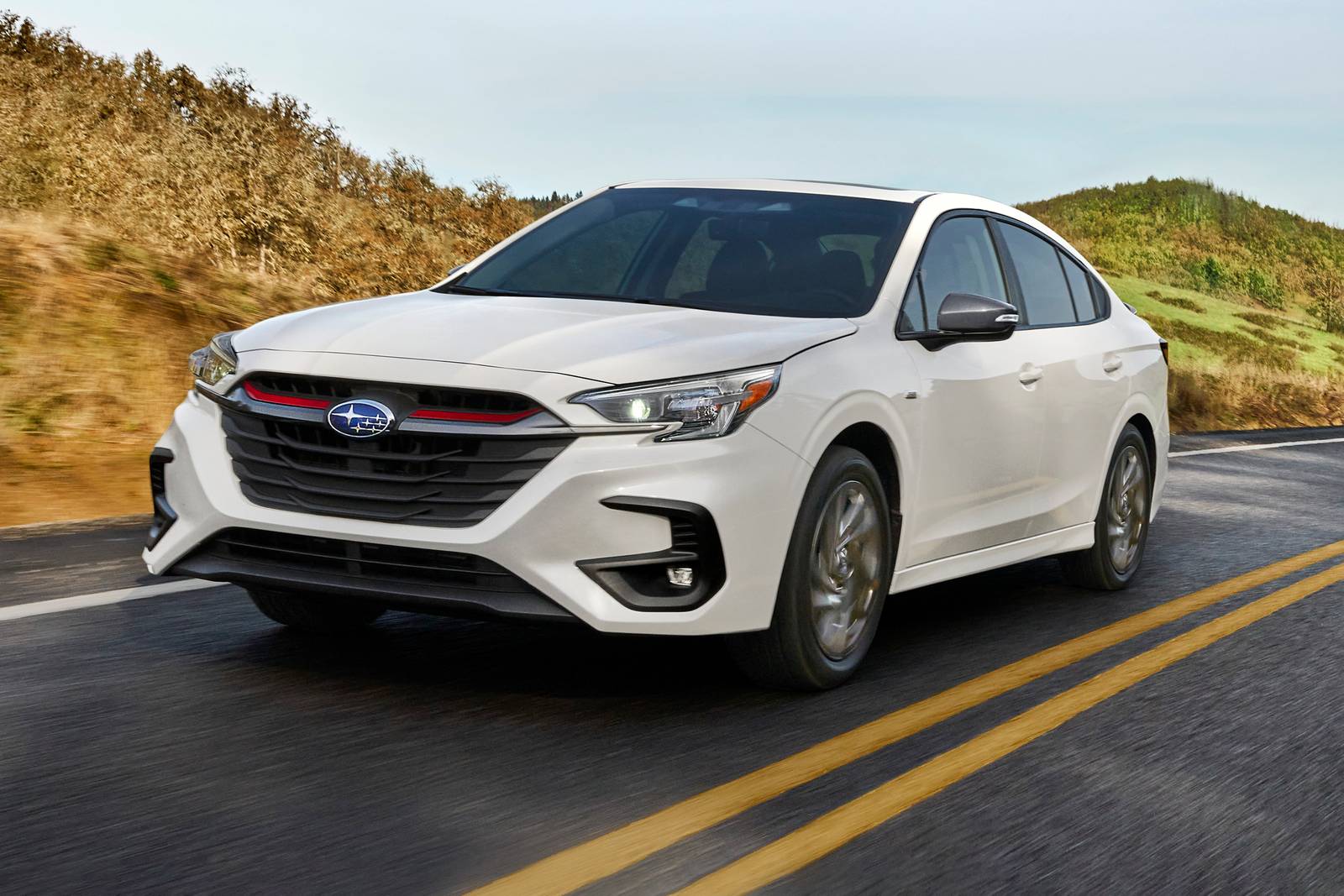
2026 Honda Accord vs 2026 Kia K5

2026 Honda Accord vs 2026 Kia K5 — two of the most compelling midsize sedans on the market today, each offering a unique blend of performance, technology, and value for the modern buyer. As the family sedan segment continues to shrink under the relentless pressure of crossovers and SUVs, these two stalwarts refuse to go quietly into the night. In fact, both the Accord and the K5 have evolved into sophisticated, well-rounded vehicles that challenge the notion that sedans are a dying breed. Whether you’re a first-time buyer, a growing family, or a commuter looking for the perfect daily driver, this comprehensive buyer’s guide will walk you through every critical detail you need to know before making your decision.
The midsize sedan segment has always been fiercely competitive, and 2026 is no exception. With the Toyota Camry, Hyundai Sonata, and Nissan Altima also vying for your attention, the Honda Accord and Kia K5 stand out as two of the most well-rounded options available. But which one deserves your hard-earned money? This guide breaks down pricing, performance, fuel economy, interior quality, technology, safety, reliability, and long-term value to help you make an informed choice.
Table of Contents
- Pricing and Trim Levels
- Engine, Transmission, and Performance
- Fuel Economy and Real-World Efficiency
- Interior, Comfort, and Cargo Space
- Infotainment and Connectivity
- Safety Ratings and Driver-Assistance Features
- Warranty and Maintenance Coverage
- Reliability and Resale Value
- Driving Dynamics and Ride Quality
- Final Verdict: Which Sedan Should You Buy?
1. Pricing and Trim Levels
Price is often the first consideration for any car buyer, and both the 2026 Honda Accord and 2026 Kia K5 offer competitive starting points that undercut many rivals while delivering exceptional value.
2026 Honda Accord Pricing
The 2026 Honda Accord starts at approximately $28,295 for the base LX trim, with the range-topping Touring Hybrid commanding around $39,300. For 2026, Honda made several thoughtful updates: the LX and SE trims now feature a larger infotainment screen, the Sport models gain more black exterior accents, and the SE receives upgraded 19-inch wheels (up from 17 inches). The Accord is available in six trim levels: LX, SE, Sport Hybrid, EX-L Hybrid, Sport-L Hybrid, and Touring Hybrid. The two lowest trims (LX and SE) are powered by the turbocharged 1.5-liter four-cylinder engine, while all higher trims come standard with the hybrid powertrain.
2026 Kia K5 Pricing
The 2026 Kia K5 starts at $27,390 for the LXS trim, with the fully loaded EX reaching $36,235 including destination charges. The K5 lineup consists of four trims: LXS, GT-Line, GT, and EX. The LXS and GT-Line are powered by the 2.5-liter naturally aspirated four-cylinder, while the GT-Line offers an available all-wheel-drive option. The GT stands alone with its turbocharged 2.5-liter engine producing 290 horsepower, and the EX returns to the naturally aspirated engine but adds premium features like ventilated seats, a panoramic sunroof, and a surround-view camera system.
On paper, the Kia K5 undercuts the Honda Accord by roughly $900 at the entry level. However, when comparing similarly equipped models, the gap narrows considerably. The K5 GT-Line FWD starts at $28,390, while the Accord LX starts at $28,295 — essentially a wash. Where the K5 pulls ahead is in standard equipment; even the base LXS includes features like wireless Apple CarPlay and Android Auto, LED headlights, and rear cross-traffic alert that may cost extra or require higher trims on the Accord.
2. Engine, Transmission, and Performance
Performance expectations for a midsize sedan have evolved significantly. Today’s buyers want enough power for confident highway merging and passing, but they also prioritize efficiency and refinement. Both the Accord and K5 deliver, albeit with very different philosophies.
Honda Accord Powertrains
The 2026 Honda Accord offers two distinct powertrain options. The base engine is a turbocharged 1.5-liter inline-four producing 192 horsepower and 192 lb-ft of torque, paired exclusively with a continuously variable transmission (CVT). This engine delivers adequate performance for daily driving, with a 0-60 mph time of approximately 7.3 seconds. The real star of the lineup, however, is the hybrid powertrain found on the Sport, EX-L, Sport-L, and Touring trims. This system combines a 2.0-liter Atkinson-cycle inline-four with two electric motors for a combined output of 204 horsepower and 247 lb-ft of torque. Despite the added weight of the hybrid components, the hybrid Accord is actually quicker, reaching 60 mph in just 6.7 seconds.
Notably, the Accord is exclusively front-wheel drive for 2026. Honda has chosen not to offer all-wheel drive, which may be a dealbreaker for buyers in snowy climates. The hybrid system uses a direct-drive transmission rather than a traditional automatic or CVT, which Honda has cleverly programmed to simulate the feel of conventional gear changes.
Kia K5 Powertrains
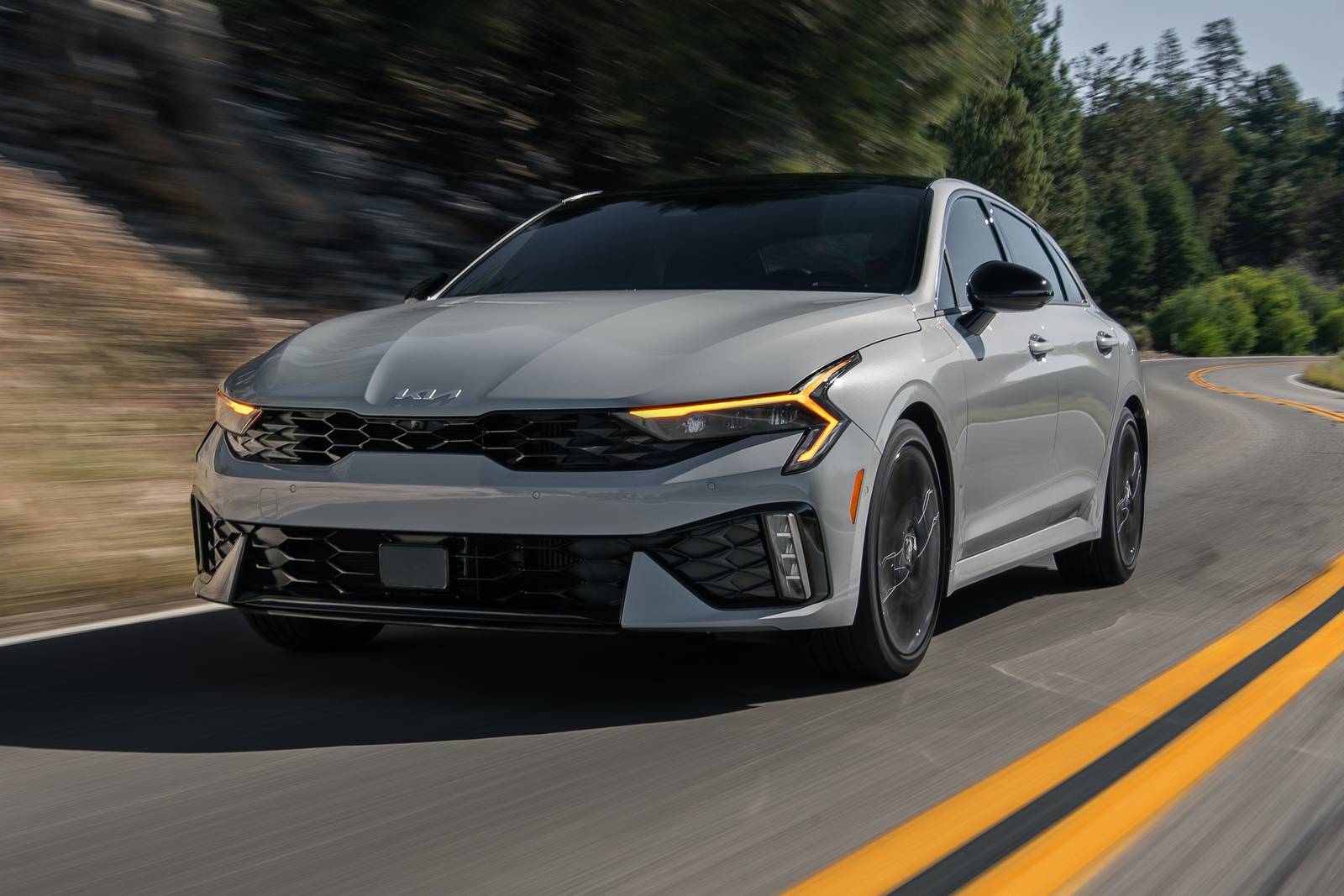
The 2026 Kia K5 offers a broader range of powertrain choices. The majority of trims (LXS, GT-Line, and EX) use a 2.5-liter naturally aspirated inline-four producing 191 horsepower and 181.5 lb-ft of torque, mated to an eight-speed automatic transmission. This engine delivers competitive performance and is available with either front-wheel drive or all-wheel drive on the GT-Line. The headline-grabber is the K5 GT, which features a turbocharged 2.5-liter four-cylinder generating 290 horsepower and 311 lb-ft of torque, paired with an eight-speed dual-clutch automatic transmission. The GT sprints to 60 mph in just 5.2 seconds, making it one of the quickest sedans in the segment.
The availability of all-wheel drive on the GT-Line gives the K5 a significant advantage for buyers in regions with harsh winters. The GT’s performance credentials are further bolstered by larger brakes, a unique sport-tuned suspension, and 19-inch wheels with wider tires. However, the GT comes exclusively with front-wheel drive, which can lead to noticeable torque steer under hard acceleration.
Performance Comparison
| Metric | Honda Accord (1.5T) | Honda Accord Hybrid | Kia K5 (2.5L) | Kia K5 GT |
|---|---|---|---|---|
| Horsepower | 192 hp | 204 hp | 191 hp | 290 hp |
| Torque | 192 lb-ft | 247 lb-ft | 181.5 lb-ft | 311 lb-ft |
| Transmission | CVT | Direct-Drive | 8-Speed Auto | 8-Speed DCT |
| 0-60 mph | 7.3 sec | 6.7 sec | ~7.5 sec | 5.2 sec |
| Drivetrain | FWD | FWD | FWD/AWD | FWD |
For buyers prioritizing raw performance, the Kia K5 GT is the clear winner. Its 290 horsepower and 5.2-second 0-60 time put it in a different league than any Accord variant. However, for the average commuter, the Accord Hybrid offers the best balance of power and efficiency, with its 6.7-second sprint to 60 mph and exceptional fuel economy.
3. Fuel Economy and Real-World Efficiency
Fuel economy remains one of the most important factors for sedan buyers, and this is where the Honda Accord establishes a commanding lead — particularly in hybrid form.
Honda Accord Fuel Economy
The non-hybrid Accord with the 1.5-liter turbo engine achieves EPA ratings of 29 mpg city, 37 mpg highway, and 32 mpg combined. In real-world testing at a steady 75 mph, Car and Driver recorded 40 mpg — an impressive overachievement. The hybrid powertrain, however, is where the Accord truly shines. The EX-L Hybrid on 17-inch wheels is rated at 51 mpg city, 44 mpg highway, and 48 mpg combined. Even the larger-wheeled Sport, Sport-L, and Touring hybrids still manage 46 mpg city, 41 mpg highway, and 44 mpg combined. Real-world highway testing of a hybrid Touring yielded 36 mpg at 75 mph, which is slightly below the EPA highway figure but still excellent for a vehicle of this size.
Kia K5 Fuel Economy
The naturally aspirated K5 with front-wheel drive achieves EPA ratings of 26 mpg city, 37 mpg highway, and 30 mpg combined. Opting for all-wheel drive on the GT-Line drops those figures to 24 mpg city, 33 mpg highway, and 27 mpg combined. The performance-oriented GT is rated at 23 mpg city, 33 mpg highway, and 27 mpg combined. In Car and Driver’s real-world 75-mph highway test, the GT overperformed its rating, returning 36 mpg. The K5 uses regular unleaded gasoline across all trims, which helps keep operating costs down.
Efficiency Comparison
| Model | City MPG | Highway MPG | Combined MPG |
|---|---|---|---|
| Accord 1.5T | 29 | 37 | 32 |
| Accord Hybrid (EX-L) | 51 | 44 | 48 |
| Accord Hybrid (Sport/Touring) | 46 | 41 | 44 |
| K5 2.5L FWD | 26 | 37 | 30 |
| K5 GT-Line AWD | 24 | 33 | 27 |
| K5 GT | 23 | 33 | 27 |
If fuel efficiency is your top priority, the Accord Hybrid is the undisputed champion. Its 48 mpg combined rating (EX-L) represents a 60% improvement over the most efficient K5. Over 15,000 miles of annual driving, an Accord Hybrid owner would spend approximately $750 less on fuel than a K5 owner (assuming $3.50/gallon gas). Over five years, those savings approach $3,750 — a significant consideration for budget-conscious buyers.
4. Interior, Comfort, and Cargo Space
Both sedans offer spacious, well-appointed interiors, but they approach cabin design with different philosophies. The Accord prioritizes understated elegance and maximum practicality, while the K5 leans into bold styling and premium materials that punch above its price point.
Honda Accord Interior
The Accord’s interior follows Honda’s current design language, with a clean horizontal dashboard, honeycomb-patterned air vent trim (shared with the Civic and CR-V), and high-quality materials throughout. The front seats are supportive but could use additional padding, according to some reviewers. Rear-seat legroom is class-leading, making the Accord an excellent choice for families or anyone who regularly transports adults in the back. However, the sloping roofline means taller passengers need to duck when entering, and headroom is merely adequate rather than generous.
The Accord’s trunk measures 16.7 cubic feet, which is among the largest in the segment. In practical terms, it can accommodate seven carry-on suitcases with the seats up and 20 cases with the rear seats folded. The wide trunk opening and low liftover height make loading bulky items easy. Interior storage is also well thought out, with a large center console bin, generous door pockets, and cupholders designed to accommodate large water bottles.
Kia K5 Interior
The K5’s interior is arguably more visually striking than the Accord’s. Kia has incorporated wood trim on the dash and doors, ambient interior lighting, and a generally more upscale aesthetic. The GT-Line and above add leather-wrapped steering wheels, power-adjustable driver’s seats, and available heated and ventilated front seats. The EX trim goes further with a panoramic sunroof, wireless charging pad, and genuine leather upholstery.
However, the K5’s driver’s seat sits higher than ideal, even at its lowest setting, which can be uncomfortable for taller drivers. Rear-seat legroom is generous, matching the Accord’s spaciousness, and the trunk offers 15.6 cubic feet of cargo capacity — slightly smaller than the Accord but still competitive. The K5 also managed to fit seven carry-on suitcases in its trunk during testing, proving that the difference in cubic footage doesn’t always translate to real-world usability.
Interior Comparison
| Dimension | Honda Accord | Kia K5 |
|---|---|---|
| Front Headroom | 39.5 in | 40.2 in |
| Front Legroom | 42.3 in | 46.1 in |
| Rear Headroom | 37.3 in | 37.4 in |
| Rear Legroom | 40.8 in | 35.2 in |
| Trunk Volume | 16.7 cu ft | 15.6 cu ft |
| Passenger Volume | 105.7 cu ft | 121.3 cu ft (EPA total) |
The Accord edges ahead in cargo capacity and rear legroom, while the K5 offers more front legroom and a slightly airier cabin feel. Both vehicles provide excellent space for five adults, but the Accord’s larger trunk gives it a practical advantage for road trips and cargo-heavy lifestyles.
5. Infotainment and Connectivity
Modern buyers expect their vehicles to function as extensions of their digital lives, and both the Accord and K5 deliver robust technology suites — though with different approaches to implementation.
Honda Accord Technology
The 2026 Accord features either a 9.0-inch or 12.3-inch touchscreen infotainment system, depending on trim level. The LX and SE receive the smaller screen for 2026 (an upgrade from previous years), while Sport and above get the larger 12.3-inch display. All models come standard with a 10.2-inch digital gauge cluster, wireless Apple CarPlay and Android Auto, and a wireless phone charger (on hybrid models). The top-tier Touring adds a 12-speaker Bose audio system, a 6.0-inch head-up display, and Google voice assistant integration.
Honda’s infotainment interface is generally intuitive, with large touch targets and logical menu structures. However, some reviewers note that the base 9.0-inch screen feels small by modern standards, and certain desirable features like Google integration are restricted to the top Touring trim — a frustrating example of feature gatekeeping.
Kia K5 Technology
The K5 comes standard with a 12.3-inch touchscreen infotainment system across all trims — a significant advantage over the Accord’s base screen. This display shares a bezel with the gauge cluster, creating a unified “dual panoramic display” appearance. Higher trims upgrade to a 12.0-inch digital instrument cluster. Wireless Apple CarPlay and Android Auto are standard on all K5 models, as is a wireless charging pad on the GT-Line and above. The available 12-speaker Bose audio system delivers excellent sound quality, and the GT trim can be equipped with the GT1 Package, which adds a 12.3-inch TFT curved cluster, Digital Key 2.0, surround-view monitor, and ventilated front seats.
Kia’s infotainment system is generally well-regarded for its responsiveness and ease of use. The standardization of the large touchscreen across all trims means even base-model buyers don’t feel shortchanged on technology.
Technology Comparison
| Feature | Honda Accord | Kia K5 |
|---|---|---|
| Base Touchscreen | 9.0 in | 12.3 in |
| Upgraded Touchscreen | 12.3 in | 12.3 in |
| Digital Gauge Cluster | 10.2 in (standard) | 12.0 in (available) |
| Wireless Apple CarPlay/Android Auto | Yes (all trims) | Yes (all trims) |
| Wireless Charging | Hybrid models | GT-Line and above |
| Premium Audio | 12-speaker Bose (Touring) | 12-speaker Bose (available) |
| Head-Up Display | 6.0 in (Touring) | Not available |
The K5 wins on standard screen size, while the Accord offers a head-up display that the K5 lacks. Both vehicles provide excellent smartphone integration and premium audio options. For tech-focused buyers, the K5’s standard 12.3-inch screen gives it a slight edge, though the Accord’s available head-up display is a nice premium touch.
6. Safety Ratings and Driver-Assistance Features
Safety is non-negotiable for family sedans, and both the Accord and K5 come equipped with comprehensive suites of active and passive safety features.
Honda Accord Safety
All Accords come standard with Honda Sensing, which includes automated emergency braking with pedestrian detection, lane-keeping assist, adaptive cruise control, traffic sign recognition, traffic jam assist, and automatic high-beams. The Accord has earned a 5-star overall safety rating from the NHTSA and the IIHS Top Safety Pick+ designation (based on previous model years of the same generation). Blind-spot monitoring and parking sensors are available on higher trims.
The Accord’s safety systems are generally well-calibrated, though some reviewers note that the lane-keeping system can be overly intrusive at times. The adaptive cruise control is praised for its smooth operation and ease of activation.
Kia K5 Safety
The K5 also comes standard with a robust suite of driver-assistance technology, including automated emergency braking with pedestrian detection, lane-departure warning with lane-keeping assist, adaptive cruise control, rear cross-traffic alert, and blind-spot monitoring. The K5 received a 5-star overall safety rating from the NHTSA. Higher trims add features like a surround-view camera (standard on EX, optional on GT), parking collision avoidance assist, and blind-spot monitor.
Kia’s driver aids are generally effective, though the GT’s performance tires can limit the effectiveness of certain systems in wet conditions. The standard blind-spot monitoring on all trims is a nice touch that some competitors reserve for higher grades.
Safety Feature Comparison
| Feature | Honda Accord | Kia K5 |
|---|---|---|
| Automated Emergency Braking | Standard | Standard |
| Lane-Keeping Assist | Standard | Standard |
| Adaptive Cruise Control | Standard | Standard |
| Blind-Spot Monitoring | Available | Standard |
| Rear Cross-Traffic Alert | Standard | Standard |
| Surround-View Camera | Not available | Standard (EX) / Optional (GT) |
| NHTSA Overall Rating | 5 Stars | 5 Stars |
| IIHS Rating | Top Safety Pick+ | Top Safety Pick (previous gen) |
Both vehicles offer excellent safety credentials, but the K5’s standard blind-spot monitoring across all trims and available surround-view camera give it a slight equipment advantage. The Accord counters with its IIHS Top Safety Pick+ rating and Honda’s reputation for structural safety excellence.
7. Warranty and Maintenance Coverage
Warranty coverage can provide significant peace of mind and long-term value, and this is an area where Kia has historically dominated the industry.
Honda Accord Warranty
Honda offers a 3-year/36,000-mile limited warranty and a 5-year/60,000-mile powertrain warranty. Roadside assistance is included for the duration of the limited warranty. Where Honda stands out is its complimentary scheduled maintenance program, which covers one year or 12,000 miles of basic service — a perk that Kia does not match. However, Honda’s warranty periods are shorter than those offered by Kia and Hyundai, which may concern buyers planning to keep their vehicles long-term.
Kia K5 Warranty
Kia’s warranty coverage is among the best in the business. The K5 comes with a 5-year/60,000-mile limited warranty and an industry-leading 10-year/100,000-mile powertrain warranty. This powertrain coverage is double what Honda offers and provides exceptional protection for the engine, transmission, and drivetrain components. However, Kia does not include complimentary scheduled maintenance, which means owners are responsible for all routine service costs from day one.
Warranty Comparison
| Coverage | Honda Accord | Kia K5 |
|---|---|---|
| Limited Warranty | 3 years / 36,000 miles | 5 years / 60,000 miles |
| Powertrain Warranty | 5 years / 60,000 miles | 10 years / 100,000 miles |
| Roadside Assistance | 3 years / 36,000 miles | 5 years / 60,000 miles |
| Complimentary Maintenance | 1 year / 12,000 miles | None |
For buyers who plan to keep their vehicle beyond the standard warranty period, the K5’s 10-year/100,000-mile powertrain warranty is a compelling advantage. However, the Accord’s complimentary maintenance program provides immediate value for the first year of ownership. The choice here depends on your ownership timeline and risk tolerance.
8. Reliability and Resale Value
Long-term reliability and resale value are critical considerations that often get overlooked in the excitement of a new car purchase. Both Honda and Kia have made significant strides in these areas, though their reputations differ.
Honda Accord Reliability
The Honda Accord has built its reputation over four decades on the pillars of reliability, durability, and low cost of ownership. The current 11th-generation Accord, introduced in 2023, continues this tradition with proven powertrains and high-quality construction. Honda’s 1.5-liter turbo engine and hybrid system have been thoroughly vetted across multiple models and model years. The Accord consistently ranks among the top vehicles in J.D. Power dependability studies and enjoys some of the highest resale values in the midsize sedan segment.
According to Kelley Blue Book, the Accord’s 5-year cost to own is competitive, with strong residual values that help offset higher initial purchase prices. The hybrid models, in particular, hold their value well due to high demand for fuel-efficient vehicles.
Kia K5 Reliability
Kia has transformed its reliability reputation over the past decade, moving from a budget brand with questionable quality to a manufacturer that consistently earns high marks from industry analysts. The K5 shares its platform and powertrains with the Hyundai Sonata, which has proven reliable in long-term testing. Kia’s industry-leading warranty is a testament to the company’s confidence in its products.
However, the K5’s 5-year cost to own ranges from approximately $61,080 (LXS) to $69,243 (GT), which includes depreciation, fuel, insurance, maintenance, and repairs. The K5’s bolder styling may appeal more to younger buyers, but its resale value typically trails the Accord’s historically strong residuals. The GT model, while exciting to drive, may depreciate faster due to its performance focus and higher initial price.
5-Year Cost to Own Comparison (Kia K5)
| Cost Category | K5 LXS | K5 GT-Line | K5 GT | K5 EX |
|---|---|---|---|---|
| Fuel | $12,091 | $12,811 | $13,161 | $12,091 |
| Maintenance | $8,500 | $8,518 | $8,582 | $8,500 |
| Insurance | $16,125 | $16,340 | $17,845 | $16,485 |
| Repairs | $695 | $705 | $695 | $695 |
| Depreciation | $15,344 | $16,926 | $18,973 | $19,981 |
| Total 5-Year Cost | $61,080 | $64,305 | $69,243 | $67,967 |
The Accord’s reputation for bulletproof reliability and strong resale value gives it an edge for buyers planning to own their vehicle for many years or who prioritize maximum return on investment at trade-in time. The K5’s lower initial price and generous warranty help offset its higher depreciation, making it an attractive option for buyers who prioritize upfront savings.
9. Driving Dynamics and Ride Quality
How a car drives is arguably the most subjective aspect of ownership, but it’s also where the Honda Accord has historically separated itself from the competition. The 2026 model continues this tradition.
Honda Accord Driving Experience
The Accord has been a fixture on Car and Driver’s 10Best list for years, and the 2026 model earns that distinction again. Its handling transcends the family sedan class, with precise steering, well-controlled body motions, and a compliant ride that manages to be both comfortable and engaging. The suspension tuning strikes a masterful balance between absorbing road imperfections and maintaining composure through corners. The hybrid powertrain, despite its complexity, delivers smooth, linear acceleration that feels more refined than the base engine’s CVT.
Some reviewers note that the Accord’s steering feel isn’t as communicative as earlier generations, and there is more wind and road noise in the cabin than some rivals. However, the overall driving experience remains a benchmark for the segment. The Accord’s 0.85g skidpad performance (non-hybrid) and 0.89g (hybrid Touring) demonstrate genuine athletic capability.
Kia K5 Driving Experience
The K5 offers two distinct personalities depending on trim. The LXS, GT-Line, and EX deliver a comfortable, composed ride that prioritizes isolation over engagement. The suspension soaks up bumps effectively, and the eight-speed automatic shifts smoothly. The naturally aspirated engine provides adequate power for daily driving, though it lacks the urgency of the Accord Hybrid.
The GT model is an entirely different animal. With its sport-tuned suspension, larger brakes, and 290 horsepower turbo engine, it delivers genuine sports sedan performance. The 0-60 time of 5.2 seconds puts it in the company of much more expensive vehicles. However, the GT’s all-season tires limit its grip potential, and some reviewers wish Kia offered summer tires as an option. The dual-clutch transmission shifts quickly but can be jerky at low speeds. The GT’s ride is noticeably firmer than lesser K5s, which may not suit buyers seeking maximum comfort.
The K5’s available all-wheel drive on the GT-Line provides an advantage in inclement weather, something the Accord cannot match. However, the AWD system adds weight and slightly dulls steering response compared to the front-drive variant.
Braking Performance
| Model | 70-0 mph Braking Distance |
|---|---|
| Accord 1.5T | 184 ft |
| Accord Hybrid Touring | 165 ft |
| Kia K5 GT | 163 ft |
Both vehicles offer confident braking performance, with the K5 GT and Accord Hybrid Touring nearly tied at approximately 163-165 feet from 70 mph. The base Accord’s longer stopping distance reflects its smaller brake hardware.
10. Final Verdict: Which Sedan Should You Buy?
After evaluating every critical aspect of these two exceptional sedans, the right choice depends entirely on your priorities as a buyer. Both the 2026 Honda Accord and 2026 Kia K5 are excellent vehicles that represent the best of what the shrinking midsize sedan segment has to offer.
Buy the 2026 Honda Accord If:
- Fuel efficiency is your top priority — The Accord Hybrid’s 48 mpg combined rating is unmatched in this comparison and among the best in the segment.
- You value driving dynamics and refinement — The Accord’s ride, handling, and steering precision remain class benchmarks.
- Interior space and cargo capacity matter — The 16.7 cubic foot trunk and generous rear legroom make the Accord exceptionally practical.
- Long-term reliability and resale value are important — Honda’s reputation for durability and strong residuals provides peace of mind.
- You prefer a hybrid powertrain — The Accord makes hybrid technology accessible across most of its lineup, not just as a premium option.
- You appreciate understated, timeless design — The Accord’s clean, elegant styling ages gracefully.
Buy the 2026 Kia K5 If:
- You want the most performance for your dollar — The K5 GT’s 290 horsepower and 5.2-second 0-60 time deliver sports sedan thrills at a family sedan price.
- All-wheel drive is a necessity — The available AWD on the GT-Line makes the K5 a better choice for snowy climates.
- Bold styling excites you — The K5’s aggressive, coupe-like silhouette stands out in a sea of anonymous sedans.
- You prioritize standard technology — The 12.3-inch touchscreen on every trim and standard wireless connectivity offer excellent value.
- Warranty coverage provides peace of mind — The 10-year/100,000-mile powertrain warranty is unmatched in the industry.
- You want maximum features for the money — The K5 packs more standard equipment into lower trims than most competitors.
Our Recommendation
For the average midsize sedan buyer — someone who uses their vehicle primarily for commuting, family transportation, and road trips — the 2026 Honda Accord Hybrid is the better overall choice. Its combination of exceptional fuel economy, refined driving dynamics, spacious interior, and proven reliability creates a package that is difficult to beat. The hybrid powertrain’s additional upfront cost is quickly offset by fuel savings, and the Accord’s strong resale value protects your investment over time.
However, if you live in an area with heavy snow and need all-wheel drive, or if you simply crave more excitement from your daily drive, the 2026 Kia K5 GT-Line AWD or K5 GT are compelling alternatives. The GT-Line AWD offers weather security with a reasonable price premium, while the GT delivers genuine performance credentials that embarrass many more expensive vehicles. Kia’s bold styling and generous warranty further sweeten the deal.
Ultimately, you cannot make a bad choice between these two sedans. Both offer exceptional value, modern technology, and the kind of well-rounded competence that has made the midsize sedan a cornerstone of the American automotive landscape for decades. Test drive both, trust your instincts, and enjoy the knowledge that whichever you choose, you’re getting one of the best family sedans available in 2026.
Frequently Asked Questions
Is the 2026 Honda Accord or Kia K5 more reliable?
Both vehicles offer strong reliability, but the Honda Accord has a longer track record of proven durability across multiple generations. Kia has dramatically improved its quality in recent years, and its industry-leading warranty reflects that confidence. For maximum long-term peace of mind, the Accord’s decades of dependability data give it a slight edge.
Which gets better gas mileage, the Accord or K5?
The Honda Accord Hybrid is significantly more fuel-efficient, achieving up to 48 mpg combined compared to the K5’s maximum of 30 mpg combined. Even the non-hybrid Accord (32 mpg combined) beats the most efficient K5. If fuel economy is a priority, the Accord is the clear winner.
Does the 2026 Honda Accord offer all-wheel drive?
No, the 2026 Honda Accord is exclusively front-wheel drive. If you need all-wheel drive, the Kia K5 GT-Line is your choice in this comparison.
Is the Kia K5 GT faster than the Honda Accord?
Yes, significantly. The K5 GT reaches 60 mph in 5.2 seconds, while the quickest Accord (the hybrid) takes 6.7 seconds. The base Accord engine needs 7.3 seconds. The K5 GT is one of the fastest sedans in its class.
Which has the better warranty, Honda or Kia?
Kia offers the better warranty coverage, with a 5-year/60,000-mile limited warranty and a 10-year/100,000-mile powertrain warranty. Honda provides 3-year/36,000-mile limited and 5-year/60,000-mile powertrain coverage. However, Honda includes one year of complimentary maintenance, which Kia does not offer.
How much does the 2026 Honda Accord cost?
The 2026 Honda Accord starts at approximately $28,295 for the LX trim and ranges up to $39,300 for the Touring Hybrid. The popular EX-L Hybrid trim starts around $34,940.
How much does the 2026 Kia K5 cost?
The 2026 Kia K5 starts at $27,390 for the LXS trim and reaches $36,235 for the fully loaded EX. The performance-oriented GT starts at $33,490. The popular GT-Line FWD begins at $28,390, with AWD adding approximately $1,600.