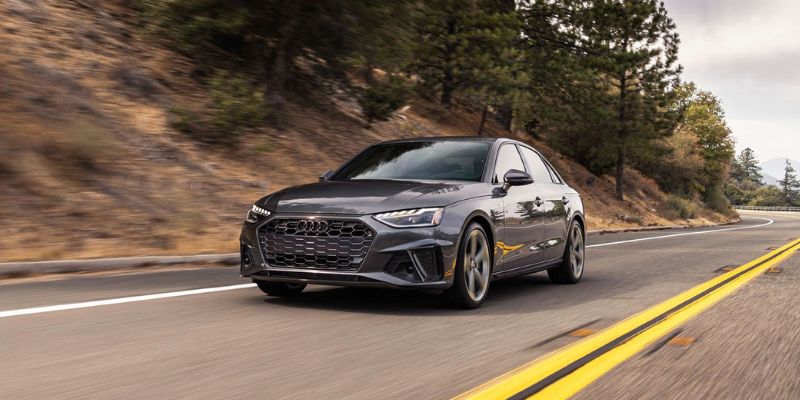
2026 Honda Civic vs 2025 Hyundai Elantra N
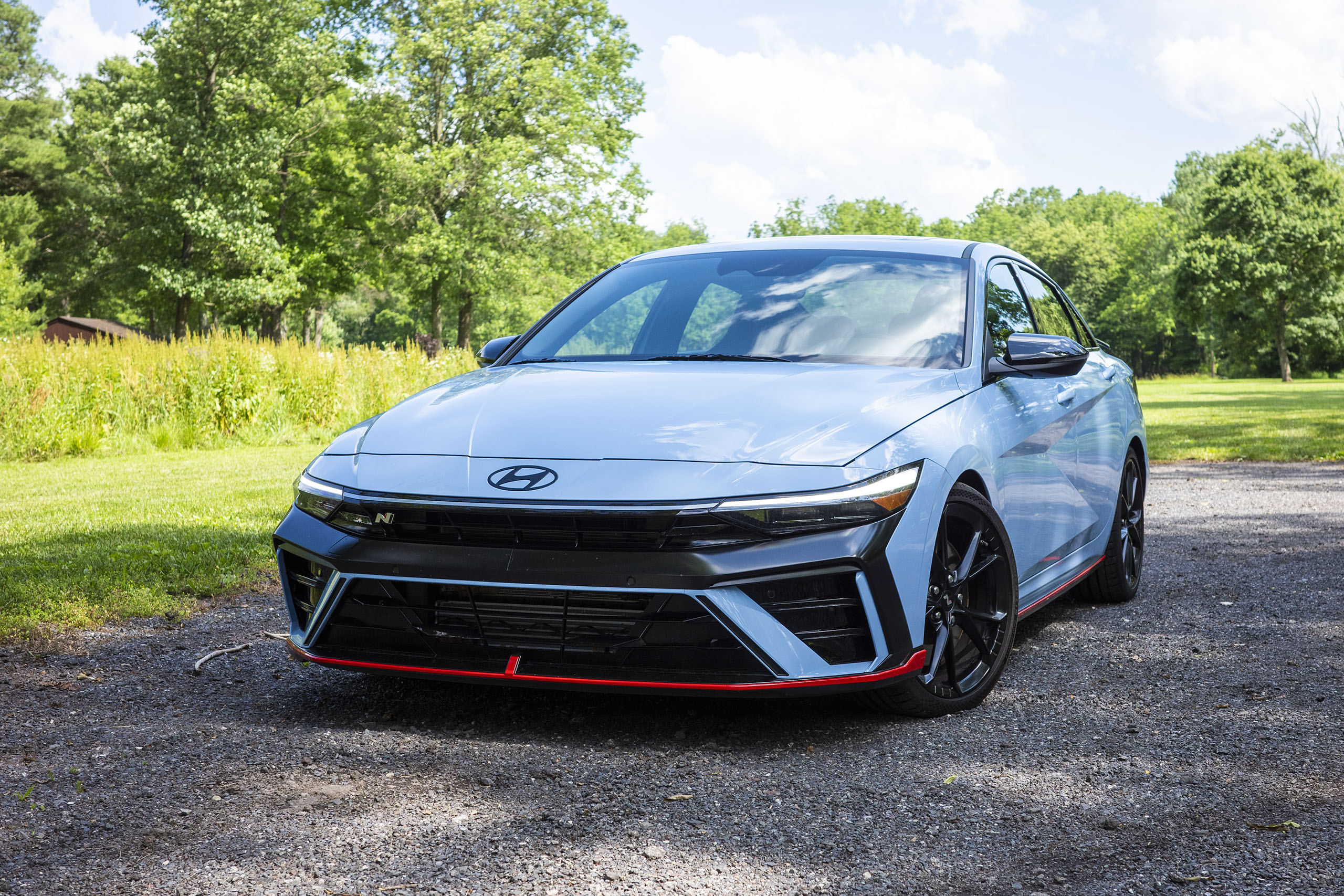
2026 Honda Civic vs 2025 Hyundai Elantra N — if you’re shopping for a compact performance sedan in 2026, this is the comparison that matters most. Two front-wheel-drive legends, two very different philosophies, and one big question: which one deserves your hard-earned money? Whether you’re a daily commuter who wants weekend thrills, a track-day enthusiast on a budget, or simply someone who refuses to settle for boring transportation, this comprehensive buyer’s guide breaks down every spec, feature, and dollar to help you make the right call.
Table of Contents
- Overview: Two Different Approaches to Performance
- Pricing and Value Comparison
- Performance and Powertrain Breakdown
- Handling, Suspension, and Driving Dynamics
- Interior, Technology, and Comfort
- Safety Features and Crash Test Ratings
- Fuel Economy and Real-World Efficiency
- Warranty and Ownership Costs
- Which One Should You Buy? Final Verdict
- Frequently Asked Questions (FAQ)
1. Overview: Two Different Approaches to Performance
The 2026 Honda Civic and 2025 Hyundai Elantra N represent two distinct philosophies in the compact performance sedan segment. The Civic, now in its eleventh generation, continues Honda’s tradition of offering a scalable platform — from the efficient 150-horsepower LX all the way up to the 315-horsepower Type R hatchback. The Elantra N, meanwhile, is a single-purpose performance machine: one trim, one mission, maximum fun.
For 2026, the Honda Civic carries over with no major changes, maintaining its position as a Car and Driver 10Best winner for the twelfth time. The lineup spans the base LX sedan ($25,890), the Sport sedan ($27,890), the enthusiast-focused Si sedan ($32,690), and the flagship Type R hatchback ($48,090). The Civic is available as both a sedan and hatchback, with hybrid powertrains offering up to 50 mpg city.
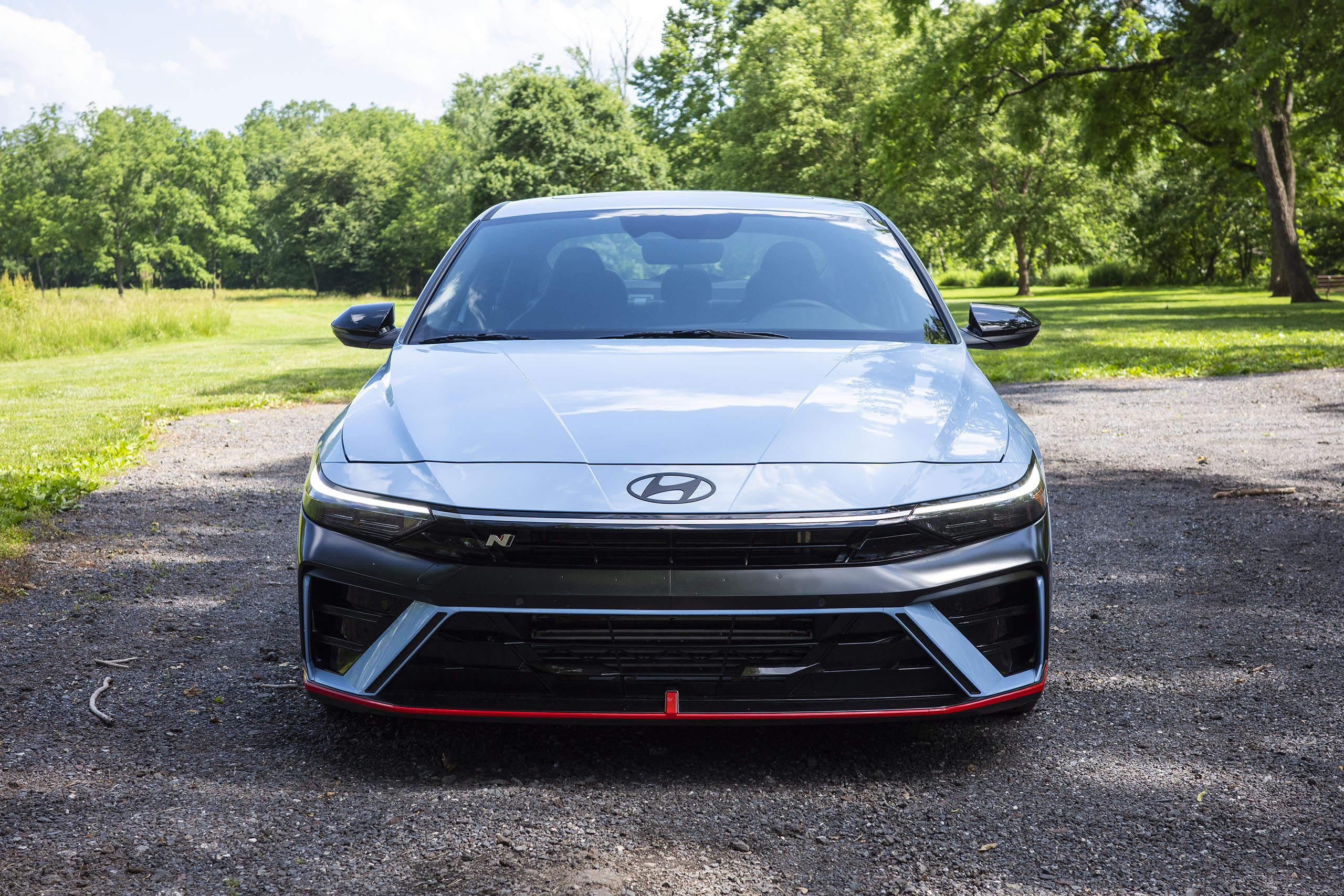
The 2025 Hyundai Elantra N starts at $35,100 and represents Hyundai’s N Division at its most accessible. With a 276-horsepower turbocharged engine, available six-speed manual or eight-speed dual-clutch automatic transmission, and a chassis tuned by the same team behind Hyundai’s World Rally Championship efforts, the Elantra N is a legitimate sports sedan disguised as a compact car. It recently received a midlife facelift that refined its styling, quieted its exhaust slightly, and added more advanced safety tech.
2. Pricing and Value Comparison
Price is often the deciding factor, and this is where the two cars diverge significantly. The 2026 Honda Civic offers a much broader price spectrum, while the 2025 Hyundai Elantra N occupies a specific niche.
| Vehicle | Starting MSRP | Top Trim MSRP | Transmission |
|---|---|---|---|
| 2026 Honda Civic LX | $25,890 | — | CVT |
| 2026 Honda Civic Sport | $27,890 | — | CVT |
| 2026 Honda Civic Si | $32,690 | — | 6-speed manual |
| 2026 Honda Civic Type R | $48,090 | — | 6-speed manual |
| 2025 Hyundai Elantra N (Manual) | $35,100 | $36,600 (DCT) | 6-speed manual / 8-speed DCT |
The Elantra N’s closest Civic competitor is the Si, with roughly a $2,400 price gap in the Elantra’s favor. However, the Elantra N delivers 76 more horsepower than the Civic Si and 31 more lb-ft of torque — a substantial performance advantage for the money. The Type R, while significantly more powerful, costs nearly $13,000 more than the Elantra N, placing it in a different budget category entirely.
When considering value, factor in Hyundai’s industry-leading warranty: 5 years/60,000 miles bumper-to-bumper and 10 years/100,000 miles powertrain coverage, compared to Honda’s 3 years/36,000 miles and 5 years/60,000 miles, respectively. Hyundai also includes 3 years of complimentary maintenance, while Honda offers just one year.
3. Performance and Powertrain Breakdown
This is where the rubber meets the road — literally. Let’s dissect what each car brings to the table under the hood.
2026 Honda Civic Powertrains
The standard 2026 Civic sedan uses a 2.0-liter naturally aspirated four-cylinder producing 150 horsepower and 133 lb-ft of torque, paired with a continuously variable transmission (CVT). It’s adequate for daily driving but far from thrilling, with a 0-60 mph time of approximately 8.9 seconds.
Step up to the Civic Si and you get a 1.5-liter turbocharged four-cylinder good for 200 horsepower and 192 lb-ft of torque, channeled exclusively through a six-speed manual transmission. The Si features a helical limited-slip differential, sport-tuned suspension, and a three-mode drive system (Normal, Sport, Individual). It’s the sweet spot for enthusiasts who want engagement without breaking the bank.
At the top sits the Civic Type R, powered by a 2.0-liter turbocharged four-cylinder churning out 315 horsepower and 310 lb-ft of torque. With a six-speed manual, adaptive dampers, Brembo front brakes, and a dual-axis front suspension that virtually eliminates torque steer, the Type R is a track weapon that happens to have four doors and a hatchback. It hits 60 mph in 4.9 seconds and runs the quarter mile in 13.5 seconds at 106 mph.
2025 Hyundai Elantra N Powertrain
The Elantra N uses a 2.0-liter turbocharged inline-four producing 276 horsepower and 289 lb-ft of torque. Buyers can choose between a six-speed manual or an eight-speed dual-clutch automatic (DCT) for an additional $1,500. The DCT is the performance choice: it enables a 0-60 mph sprint of just 4.8 seconds — quicker than the Civic Type R — and includes the N Grin Shift (NGS) function, which temporarily boosts output to 286 horsepower for 20 seconds.
The manual transmission Elantra N is slower to 60 mph (5.1–6.1 seconds depending on launch technique) but offers a more traditional enthusiast experience. However, reviewers note the manual’s clutch feel and shifter action aren’t as precise as the Civic Si’s, and the DCT is widely considered the better pairing for this engine.
| Spec | Civic Si | Civic Type R | Elantra N (DCT) | Elantra N (Manual) |
|---|---|---|---|---|
| Engine | 1.5L turbo I4 | 2.0L turbo I4 | 2.0L turbo I4 | 2.0L turbo I4 |
| Horsepower | 200 hp | 315 hp | 276 hp (286 w/ NGS) | 276 hp |
| Torque | 192 lb-ft | 310 lb-ft | 289 lb-ft | 289 lb-ft |
| Transmission | 6-speed manual | 6-speed manual | 8-speed DCT | 6-speed manual |
| 0-60 mph | ~6.8 sec | 4.9 sec | 4.8 sec | 5.1–6.1 sec |
| Quarter Mile | ~15.2 sec | 13.5 sec @ 106 mph | 13.8 sec @ 103 mph | ~14.0 sec |
| Top Speed | ~137 mph | 169 mph | 155 mph | 155 mph |
4. Handling, Suspension, and Driving Dynamics
Raw numbers only tell half the story. How these cars feel from behind the wheel is what separates good performance sedans from great ones.
Honda Civic: Precision Engineering
The Civic Si features a sport-tuned suspension with stiffer springs and dampers compared to standard Civics, plus a helical limited-slip differential that helps put power down through corners. The steering is sharp and communicative, though not quite as razor-edged as the Type R’s. The Si rides on 18-inch wheels with 235/40-series tires, striking a reasonable balance between grip and ride comfort.
The Type R elevates everything with adaptive dampers, a dual-axis strut front suspension that virtually eliminates torque steer, and 19-inch wheels wrapped in Michelin Pilot Sport 4S tires measuring 265 mm wide. On the skidpad, it pulls an impressive 1.02 g. The Type R’s braking is equally formidable: 70-0 mph in just 153 feet, thanks to 13.8-inch two-piece front rotors clamped by four-piston Brembo calipers.
Hyundai Elantra N: N Division Magic
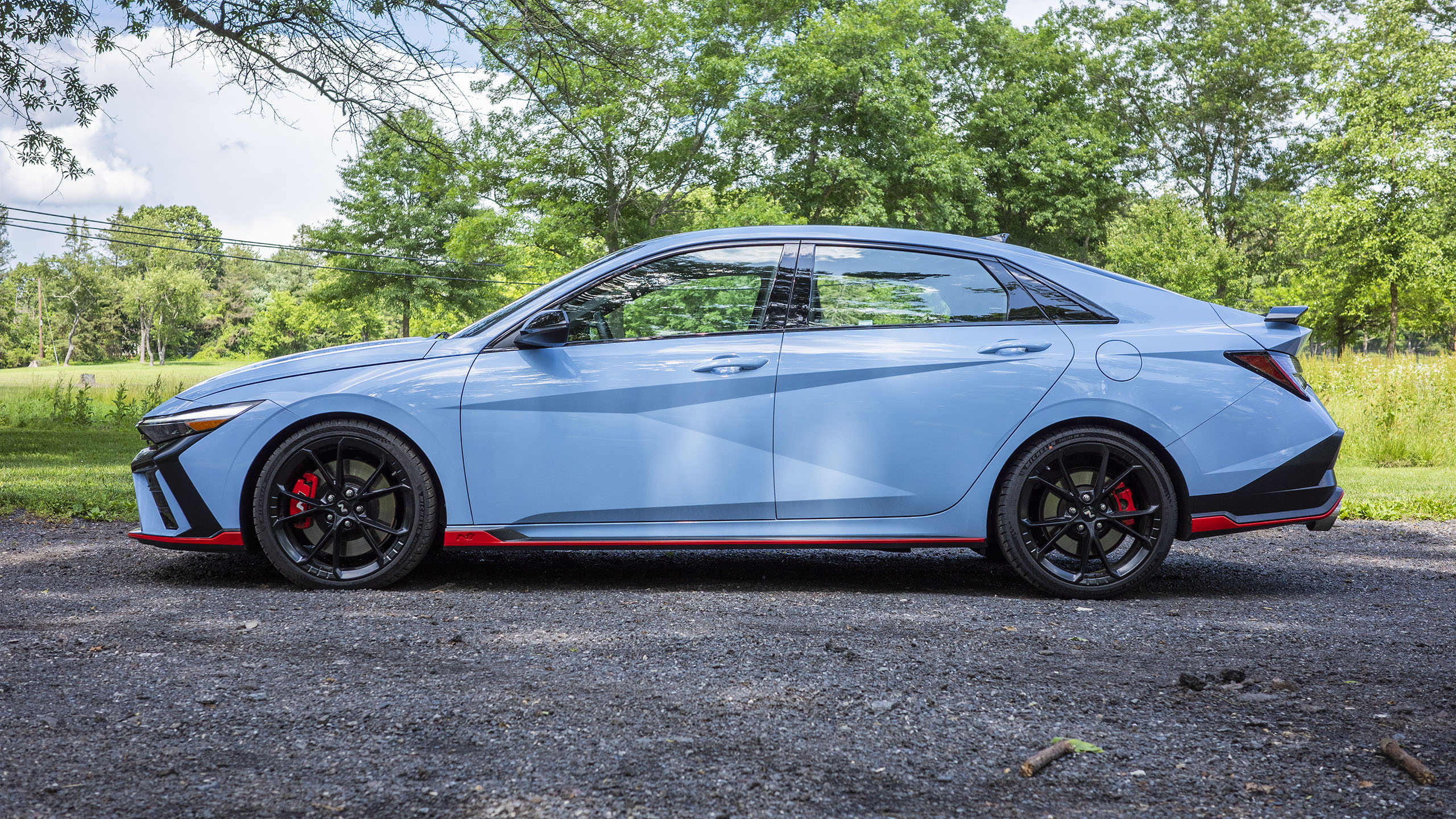
The Elantra N features an electronically controlled suspension (ECS) with multiple drive modes, an electronic limited-slip differential, and a rear chassis brace for added rigidity. It rides on 19-inch wheels with Michelin Pilot Sport 4S tires (245/35ZR-19) and stops from 70 mph in 156 feet using 14.2-inch front vented discs.
On the skidpad, the Elantra N achieves 0.99 g — remarkably close to the Type R despite costing significantly less. The steering has been praised as “a high point of the car, rivaling the best of any front-drive car on the market.” The variable exhaust system crackles and pops in Sport+ mode, though the 2025 facelift slightly muted the noise after customer feedback (and one notorious noise-ordinance incident).
Where the two diverge philosophically is in their approach to front-wheel-drive dynamics. The Civic Type R uses brake-based torque vectoring and its dual-axis suspension to manage power delivery, while the Elantra N relies more on mechanical grip and its e-LSD. Both are effective, but the Type R feels more clinical and precise, while the Elantra N feels more playful and raw.
5. Interior, Technology, and Comfort
Performance doesn’t mean sacrificing daily livability — and both cars prove it, albeit in different ways.
2026 Honda Civic Interior
The Civic’s interior is a masterclass in clean, ergonomic design. The Si gets heavily bolstered sport seats with synthetic suede upholstery, a 10.2-inch digital instrument cluster with an integrated LED shift light, and sport pedals. The Type R adds even more aggressive seating (with only two rear positions instead of three), red ambient lighting, and faux carbon-fiber trim. Both feature a 9.0-inch touchscreen with wireless Apple CarPlay and Android Auto, plus a 12-speaker Bose audio system in the Type R.
Standard safety tech across the Civic lineup includes the Honda Sensing suite: automated emergency braking, lane-keeping assist, adaptive cruise control, blind-spot monitoring, and road-sign recognition. The Civic sedan offers 14.8 cubic feet of trunk space, while the Type R hatchback swallows 25 cubic feet with the rear seats up and 20 carry-on suitcases with them folded.
2025 Hyundai Elantra N Interior
The Elantra N’s cabin is driver-focused and well-equipped. Standard features include sport bucket seats (heated and power-adjustable), a leather-wrapped steering wheel with N-mode buttons, alloy sport pedals, and a performance-focused digital display that includes a lap timer, track maps, and G-force meters. The infotainment system supports wireless Apple CarPlay and Android Auto, and Bluelink+ connectivity is included.
The Elantra N offers 14.2 cubic feet of trunk space and seating for five. Where it falls slightly behind the Civic is in material quality — while everything is well-assembled, some plastics feel cheaper than what you’d find in a similarly priced Honda. However, the Elantra N makes up for it with performance-themed features the Civic Si simply doesn’t offer, like the N Grin Shift button and configurable exhaust valves.
6. Safety Features and Crash Test Ratings
Both the 2026 Honda Civic and 2025 Hyundai Elantra N come with comprehensive safety suites, though the Civic holds a slight edge in crash-test performance.
The 2026 Honda Civic sedan and hatchback both earn a 5-star overall rating from the NHTSA and “Good” ratings across all IIHS crashworthiness categories. The Honda Sensing suite is standard on all trims and includes:
- Collision Mitigation Braking
- Road Departure Mitigation
- Adaptive Cruise Control with Low-Speed Follow
- Lane Keep Assist System
- Traffic Sign Recognition
- Blind Spot Information System
- Cross-Traffic Monitor
The 2025 Hyundai Elantra N includes Hyundai SmartSense with similar features: forward collision-avoidance assist, lane-keeping assist, blind-spot collision warning, rear cross-traffic alert, and safe exit warning. The Elantra also earns strong safety ratings, though specific 2025 NHTSA data for the Elantra N trim is less widely published than the Civic’s.
7. Fuel Economy and Real-World Efficiency
If fuel efficiency matters as much as performance, the Civic lineup offers more flexibility — especially with its hybrid option.
| Vehicle | City MPG | Highway MPG | Combined MPG | Fuel Type |
|---|---|---|---|---|
| Civic LX / Sport | 32 / 31 | 41 / 39 | 36 / 34 | Regular |
| Civic Si | 27 | 37 | 31 | Premium |
| Civic Type R | 22 | 28 | 24 | Premium |
| Civic Hybrid | 50 | 45 | 48 | Regular |
| Elantra N (Manual) | 21 | 29 | 24 | Premium |
| Elantra N (DCT) | 20 | 27 | 23 | Premium |
The Civic Hybrid is the efficiency champion here, delivering up to 50 mpg city while still hitting 60 mph in 6.1 seconds — quicker than a base Elantra. However, if you’re cross-shopping performance trims, the Civic Si edges out the Elantra N in fuel economy, while the Type R and Elantra N are roughly comparable. All performance variants require premium unleaded.
8. Warranty and Ownership Costs
Long-term ownership costs can significantly impact your decision, and this is where Hyundai flexes its competitive muscle.
| Warranty | 2026 Honda Civic | 2025 Hyundai Elantra N |
|---|---|---|
| Bumper-to-Bumper | 3 years / 36,000 miles | 5 years / 60,000 miles |
| Powertrain | 5 years / 60,000 miles | 10 years / 100,000 miles |
| Corrosion | 5 years / unlimited | 7 years / unlimited |
| Roadside Assistance | 3 years / 36,000 miles | 5 years / unlimited |
| Complimentary Maintenance | 1 year / 12,000 miles | 3 years / 36,000 miles |
Hyundai’s warranty is among the best in the industry and adds significant peace of mind for performance-car buyers who plan to drive hard. Honda’s coverage is average for the segment, though the brand’s legendary reliability reputation helps offset the shorter terms.
According to Kelley Blue Book’s 5-Year Cost to Own data, the 2026 Civic Si costs approximately $57,295 over five years, including depreciation, fuel, insurance, maintenance, and repairs. The Elantra N’s costs are comparable, though Hyundai’s longer warranty and complimentary maintenance period could reduce out-of-pocket expenses during the first three years.
9. Which One Should You Buy? Final Verdict
The choice between the 2026 Honda Civic and 2025 Hyundai Elantra N ultimately depends on your priorities, budget, and how you plan to use the car.
Buy the 2026 Honda Civic If:
- You want a broader range of options, from an efficient commuter to a track weapon
- You prefer the Civic’s cleaner, more understated design language
- You value Honda’s resale value and long-term reliability reputation
- You want the option of a hybrid powertrain for maximum efficiency
- You prefer the Si’s lighter, more tossable feel over raw power
- You can stretch your budget to the Type R for ultimate front-drive performance
Buy the 2025 Hyundai Elantra N If:
- You want the most horsepower per dollar in the compact segment
- You prefer the DCT’s lightning-fast shifts and N Grin Boost overdrive
- You value Hyundai’s superior warranty and complimentary maintenance
- You want a car that feels special and aggressive without breaking $40,000
- You enjoy a more vocal, theatrical driving experience
- You want a legitimate track car that can still haul groceries
The Bottom Line: If your budget tops out around $33,000 and you want a manual transmission, the Civic Si is the more refined choice with better fuel economy and a lighter, more agile chassis. If you can spend $35,000–$37,000 and want maximum performance, the Elantra N — especially with the DCT — delivers Type R-rivaling acceleration for thousands less. For those with $48,000 to spend, the Civic Type R remains the benchmark for front-wheel-drive performance, but the Elantra N proves you don’t need to spend that much to have serious fun.
10. Frequently Asked Questions (FAQ)
Is the 2025 Hyundai Elantra N faster than the 2026 Honda Civic Type R?
In a straight line with the DCT, yes — the Elantra N hits 60 mph in 4.8 seconds versus the Type R’s 4.9 seconds. However, the Type R has a higher top speed (169 mph vs. 155 mph), superior skidpad grip (1.02 g vs. 0.99 g), and more sophisticated suspension technology. The Type R is the faster car around a track, while the Elantra N is quicker in a drag race.
Does the 2026 Honda Civic Si have enough power?
With 200 horsepower and 192 lb-ft of torque, the Civic Si is quick enough for spirited street driving and backroad carving. It’s not as fast as the Elantra N in a straight line, but its lighter curb weight (2,952 lbs vs. 3,186 lbs) and precise chassis make it feel more agile. For many enthusiasts, the Si’s balance of power, handling, and affordability is the sweet spot.
Which has better resale value: Civic or Elantra N?
Honda Civics traditionally hold their value better than most competitors, including Hyundai. The Type R, in particular, has historically retained value exceptionally well due to its limited availability and cult following. However, the Elantra N’s strong performance credentials and Hyundai’s improving brand perception may help narrow that gap over time.
Can the Hyundai Elantra N be a daily driver?
Absolutely. Despite its performance focus, the Elantra N offers a comfortable enough ride in Normal mode, reasonable fuel economy for its power level, and all the tech and safety features you’d expect in a modern compact sedan. The DCT is particularly well-suited to daily commuting, though the firm suspension may be tiring on rough roads.
Is the 2026 Honda Civic available with all-wheel drive?
No — all 2026 Honda Civic trims, including the Si and Type R, are front-wheel drive only. If you need all-weather traction, you’ll want to invest in a quality set of winter tires for either the Civic or Elantra N.
Which car is better for track days?
The Civic Type R is the superior track car, with its adaptive dampers, superior braking, wider tires, and more advanced torque-steer mitigation. However, the Elantra N is no slouch — it turned competitive lap times at Virginia International Raceway during Car and Driver’s Lightning Lap event and offers 90% of the Type R’s track capability for $13,000 less.
2026 Acura Integra vs 2026 BMW 2-Series Buyer Guide


2026 Honda Civic Type R vs 2026 Honda Civic Hybrid
2026 Honda Civic Type R vs 2026 Honda Civic

New IRS Scam Uses AI Voice Cloning to Target Taxpayers

2025 Audi A4 vs 2026 BMW 2-Series Buyer’s Guide

2026 Honda Civic Type R vs 2026 Mazda Mazda3