2026 Honda Civic Type R vs 2026 Honda Civic Hybrid

The Honda Civic has been a cornerstone of the automotive world for over five decades. From its humble beginnings as an economical subcompact in the 1970s to its current status as one of the most respected nameplates in the industry, the Civic has earned its reputation through consistency, reliability, and an unwavering commitment to engineering excellence. For the 2026 model year, Honda offers two dramatically different interpretations of this iconic badge: the practical, everyday 2026 Honda Civic and the track-focused, adrenaline-pumping 2026 Honda Civic Type R. While they share a name and a platform, these two vehicles could not be more different in purpose, personality, and price.
This article provides a comprehensive comparison of these two remarkable machines, examining everything from their powertrains and performance to their interiors, pricing, and real-world usability. Whether you are a daily commuter seeking efficiency and comfort or a driving enthusiast craving the raw thrill of a manual transmission hot hatch, understanding the differences between these two Civics is essential before making your decision.
A Brief History of the Civic Type R
Before diving into the specifics of the 2026 models, it is worth understanding the lineage that separates these two vehicles. The standard Honda Civic has always been about accessibility and practicality. It was designed to move people efficiently and affordably, and it has done so brilliantly for generations. The Civic Type R, however, represents something entirely different. Born from Honda’s motorsport heritage, the Type R badge first appeared on the NSX-R in 1992 before making its way to the Civic lineup in 1997 with the Japanese-market EK9.
The Type R philosophy has remained remarkably consistent over three decades: take a standard Civic, strip out unnecessary weight, install a high-revving engine, upgrade the suspension and brakes, and add aggressive aerodynamics. The result is a car that can humble far more expensive machinery on a racetrack while still retaining enough practicality for daily use. The 2026 Civic Type R, codenamed FL5, represents the latest evolution of this philosophy, and many reviewers consider it the most well-rounded Type R ever created.
Powertrain and Performance: Worlds Apart
The most dramatic difference between the 2026 Honda Civic and the 2026 Honda Civic Type R lies under the hood. The standard Civic offers two powertrain options, both designed with efficiency and everyday usability in mind. The base engine is a 2.0-liter naturally aspirated inline-four producing 150 horsepower and 133 lb-ft of torque. This engine is paired with a continuously variable transmission (CVT) and delivers adequate performance for urban commuting and highway cruising. It is not quick by any measure, with 0-60 mph times hovering around 8.9 seconds, but it is smooth, reliable, and remarkably fuel-efficient.
For those seeking more power without sacrificing efficiency, the 2026 Civic also offers a hybrid powertrain. This system combines a 2.0-liter Atkinson-cycle inline-four with two electric motors to produce a combined 200 horsepower. The hybrid Civic is genuinely quick, achieving 0-60 mph in approximately 6.1 seconds, and it returns an EPA-estimated 50 mpg in city driving and 47 mpg on the highway. This powertrain has been praised for its seamless integration of electric and gasoline power, offering strong low-end torque and a refined driving experience that rivals more expensive hybrid sedans.
The Civic Type R, in stark contrast, is all about unapologetic performance. Its heart is a 2.0-liter turbocharged and intercooled inline-four engine featuring Honda’s legendary VTEC variable valve timing. This powerplant generates a staggering 315 horsepower at 6,500 rpm and 310 lb-ft of torque at 2,600 rpm. Unlike the standard Civic, which sends power through a CVT, the Type R exclusively pairs its engine with a short-throw six-speed manual transmission. There is no automatic option, no dual-clutch gearbox, and certainly no CVT. This is a driver’s car in the purest sense.
The performance numbers tell the story clearly. The Civic Type R accelerates from 0-60 mph in just 4.9 seconds, runs the quarter-mile in 13.5 seconds at 106 mph, and continues pulling all the way to a top speed of 169 mph. On a 300-foot skidpad, it generates an astonishing 1.02 g of lateral grip, a figure that would embarrass many dedicated sports cars costing twice the price. The Type R’s braking performance is equally impressive, stopping from 70 mph in just 153 feet thanks to its four-piston Brembo front calipers and 13.8-inch two-piece front rotors.
What makes the Type R’s performance so remarkable is not just the raw numbers but the sophistication with which it delivers them. Honda’s innovative dual-axis MacPherson strut front suspension virtually eliminates torque steer, a common plague of high-power front-wheel-drive vehicles. A helical limited-slip differential ensures that power is distributed effectively to the front wheels, allowing the Type R to corner with tenacious grip and minimal understeer. The adaptive damper system offers four distinct drive modes, Comfort, Sport, Individual, and the track-focused +R, allowing drivers to tailor the car’s behavior to their environment.
Transmission and Drivetrain: Manual vs. Automatic
The transmission choices alone tell you everything you need to know about the philosophical divide between these two vehicles. The standard Civic is exclusively automatic, utilizing a CVT for both its gas and hybrid powertrains. The CVT is well-tuned for its purpose, providing smooth, seamless acceleration and maximizing fuel efficiency. Paddle shifters are available on certain trims, allowing drivers to simulate gear changes, but the experience is fundamentally different from a true manual gearbox.
The Civic Type R, on the other hand, offers only a six-speed manual transmission. This is not a concession or an afterthought; it is a deliberate choice that defines the car’s character. The Type R’s gearbox features an exclusive shift link mechanism that makes each shift feel mechanical, precise, and deeply satisfying. Honda’s auto rev-match function ensures perfectly synchronized downshifts, making even novice manual drivers feel like seasoned racers. The aluminum shift knob, while beautiful, can become uncomfortably hot in direct sunlight, a small price to pay for such an engaging driving experience.
Both vehicles are front-wheel drive, but the similarities end there. The standard Civic’s front-wheel-drive layout is straightforward and effective for everyday driving. The Type R’s front-wheel-drive system is a masterpiece of engineering, using dual-axis struts, a helical limited-slip differential, and multi-link rear suspension to deliver handling precision that rivals rear-wheel-drive sports cars. The result is a car that feels alive, communicative, and utterly predictable at the limit.
Exterior Design: Understated Elegance vs. Aggressive Aerodynamics

At a glance, the 2026 Honda Civic and Civic Type R share a family resemblance. Both feature the current generation’s clean, angular design language with sharp LED headlights, a low hood line, and a fastback-inspired silhouette. However, the closer you look, the more the differences become apparent.
The standard Civic sedan and hatchback prioritize aerodynamic efficiency and understated elegance. The sedan measures 184.8 inches in length with a width of 70.9 inches, while the hatchback is slightly shorter at 179.0 inches. Both body styles feature smooth body panels, minimal cladding, and a refined presence that works equally well in a corporate parking lot or a suburban driveway. The Civic’s design is mature and sophisticated, a deliberate departure from the boy-racer styling of previous generations.
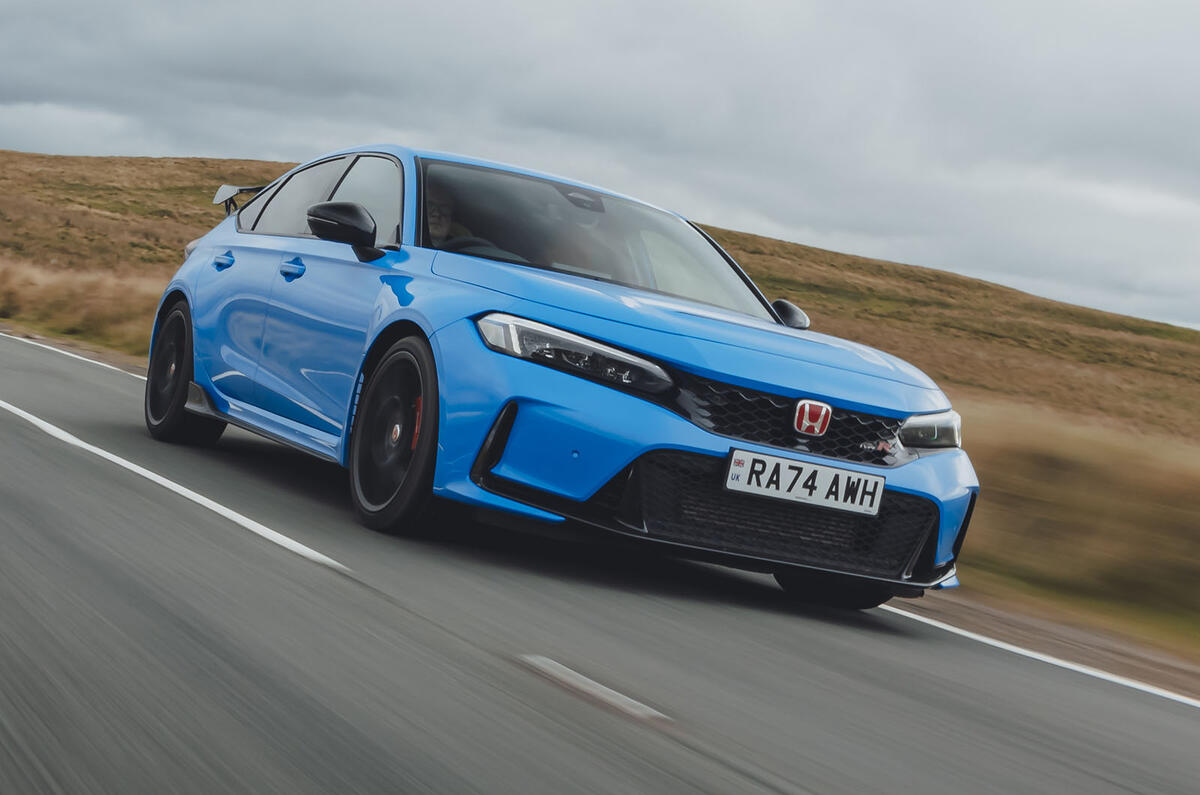
The Civic Type R takes this foundation and transforms it into something far more aggressive. At 180.9 inches long and 74.4 inches wide, the Type R is noticeably broader than its standard sibling, with wider fenders to accommodate its massive 265/30ZR-19 Michelin Pilot Sport 4S tires. The front fascia features larger air intakes for improved cooling, while the rear is dominated by a towering wing that generates genuine downforce at high speeds. A center-mounted triple-outlet exhaust system with an active exhaust valve provides a soundtrack that changes character depending on the selected drive mode. For 2026, Honda offers a new Racing Blue paint option alongside classic colors like Championship White and Rallye Red. An optional carbon-fiber rear wing is available for an additional $5,300, further reducing weight and increasing downforce.
Every exterior element on the Type R serves a functional purpose. The hood scoop feeds cool air to the turbocharger. The side skirts manage airflow along the body sides. The rear diffuser reduces aerodynamic drag. This is not a car that merely looks fast; it is a car that has been shaped by wind tunnels and racetracks to perform at the highest level.
Interior and Comfort: Practicality vs. Purpose
Step inside the standard 2026 Honda Civic, and you are greeted by one of the finest interiors in the compact car segment. Honda has elevated the Civic’s cabin with high-quality materials, thoughtful ergonomics, and a minimalist design that feels more premium than the price tag suggests. The dashboard features a clean horizontal layout with physical climate controls, a welcome relief in an era of touchscreen-dominated interiors. The seats are comfortable and supportive, with ample adjustability for drivers of all sizes. Rear-seat passengers enjoy generous legroom and headroom, though the sloping roofline can slightly compromise headroom for taller occupants in the hatchback.
The standard Civic seats five passengers and offers 15 cubic feet of trunk space in the sedan and 25 cubic feet in the hatchback with the rear seats up. Folding the rear seats expands cargo capacity significantly, making the Civic one of the most practical vehicles in its class. The infotainment system features a 9.0-inch touchscreen on higher trims, with wireless Apple CarPlay and Android Auto, a Wi-Fi hotspot, and an available Bose premium sound system. The digital driver’s display is clear and legible, with customizable layouts to suit driver preferences.
The Civic Type R’s interior shares the same fundamental architecture but is tailored for performance. The most noticeable difference is the front seats: deeply bolstered, suede-covered sport buckets that hold occupants firmly in place during aggressive cornering. These seats are manually adjustable and lack heating, a curious omission at this price point, but their comfort and support during spirited driving is unmatched. The steering wheel is wrapped in suede for maximum grip, and the aluminum pedals provide a race-car aesthetic.
The Type R’s rear bench seats only two passengers, replacing the middle seat with a pair of cupholders. This reduces total passenger capacity to four but maintains the same generous legroom and headroom as the standard Civic hatchback. Cargo capacity remains impressive at 25 cubic feet with the seats up, proving that the Type R has not sacrificed practicality for performance.
The Type R also features unique performance-oriented displays, including real-time G-force readouts, temperature monitoring for the engine and transmission, and a built-in telemetry system that can log lap times and driving data. A companion smartphone app can generate overall driving scores, though this feature is best reserved for track use. The 9.0-inch touchscreen and 12-speaker Bose stereo are carried over from the standard Civic, though some reviewers note that the sound system struggles to overcome tire roar on coarse road surfaces.
Fuel Economy: Efficiency vs. Enthusiasm
If fuel economy is a priority, the standard Civic is the clear winner. The base 2.0-liter engine achieves an EPA-estimated 31 mpg in the city and 39 mpg on the highway, with a combined rating of 34 mpg. The hybrid powertrain is even more impressive, delivering 50 mpg in the city, 47 mpg on the highway, and a combined rating of 48 mpg. These figures make the Civic Hybrid one of the most fuel-efficient non-plug-in vehicles on the market, and the hybrid’s observed fuel economy of 36 mpg in mixed driving only reinforces its real-world efficiency.
The Civic Type R, predictably, is far thirstier. Its EPA ratings of 22 mpg in the city and 28 mpg on the highway reflect the demands of its high-output turbocharged engine. In real-world testing, the Type R returned 20 mpg in mixed driving and 30 mpg during a steady 75-mph highway cruise. When driven enthusiastically, fuel consumption can easily climb to 12 liters per 100 kilometers or worse. The Type R’s small 12.4-gallon fuel tank also means frequent stops at the gas station during spirited driving, with a realistic range of less than 370 miles between fill-ups.
These numbers should not surprise anyone considering a Type R. This is a car that demands premium unleaded fuel and rewards the driver with exhilarating performance in exchange. The standard Civic, by contrast, sips regular unleaded and can travel over 500 miles on a single tank in hybrid form. The choice between these two vehicles is, in many ways, a choice between efficiency and excitement.
Pricing and Value: Accessible vs. Exclusive
The 2026 Honda Civic represents exceptional value in the compact car segment. The base LX sedan starts at $24,595, while the Sport trim begins at $26,595. The Sport Hybrid, which offers the best balance of performance and efficiency, starts at $29,295, and the range-topping Sport Touring Hybrid commands $32,295. For this investment, buyers receive a well-equipped, reliable, and efficient vehicle with Honda’s comprehensive suite of safety features and a reputation for longevity that few competitors can match.
The Civic Type R exists in an entirely different pricing stratosphere. In the United States, the Type R carries a base price of approximately $43,990, with the as-tested price of a well-equipped model reaching $44,385. In Australia, the Type R starts at $79,000 drive-away, with the optional carbon-fiber rear wing pushing the price to $84,300. This represents a premium of roughly $20,000 over the most expensive standard Civic and places the Type R in competition with vehicles like the Volkswagen Golf R, Audi S3, and BMW M135i.
Whether the Type R justifies its price depends entirely on the buyer’s priorities. For enthusiasts who value driving engagement above all else, the Type R offers a level of precision and feedback that rivals cars costing twice as much. For the average consumer, however, the standard Civic provides 90 percent of the daily usability at less than 60 percent of the price. The Type R is not a rational purchase; it is an emotional one, a celebration of Honda’s engineering prowess and motorsport heritage.
Safety and Driver Assistance

Both the 2026 Honda Civic and Civic Type R come standard with Honda Sensing, the brand’s comprehensive suite of advanced driver-assistance systems. This includes automated emergency braking, lane-keeping assist, adaptive cruise control, road departure mitigation, and traffic sign recognition. Blind-spot monitoring and rear cross-traffic alert are available on higher trims of the standard Civic and standard on the Type R.
The standard Civic has earned top safety ratings from both the National Highway Traffic Safety Administration and the Insurance Institute for Highway Safety, with Good ratings in all major crash test categories. The Type R, sharing the same fundamental structure, offers comparable levels of passive safety protection. Both vehicles feature a full complement of airbags, stability control, and traction control systems.
It is worth noting that the Type R’s extreme performance capabilities demand a higher level of driver skill and responsibility. The car’s 1.02 g of lateral grip and sub-five-second 0-60 mph acceleration are not numbers to be taken lightly. While the Type R’s stability control system is expertly tuned and rarely intrusive, the car’s limits are high enough that inexperienced drivers could find themselves in challenging situations. This is a machine that rewards skill and punishes overconfidence.
Driving Experience: Two Philosophies, One Platform
Perhaps the most fascinating aspect of comparing these two vehicles is how differently they feel from behind the wheel despite sharing the same underlying platform. The standard 2026 Honda Civic is a masterclass in everyday usability. The steering is light and precise, the ride is composed and comfortable, and the cabin remains quiet even at highway speeds. The hybrid powertrain delivers smooth, effortless acceleration that makes merging and passing drama-free. The Civic is a car that fades into the background of your daily routine, reliably transporting you from point A to point B with minimal fuss and maximum efficiency.
The Civic Type R, by contrast, demands your full attention. The steering is heavier and more communicative, transmitting every nuance of the road surface to your palms. The adaptive suspension, even in Comfort mode, is firmer than the standard Civic’s setup, and in +R mode, it becomes genuinely stiff, sacrificing ride quality for maximum body control. The engine is docile below 3,000 rpm but comes alive with a surge of turbocharged torque as the revs climb. The exhaust note, while subtle in Comfort mode, becomes more aggressive in Sport and +R, though some reviewers find the synthesized sound in +R mode disappointingly artificial.
What sets the Type R apart from other hot hatches is the clarity of its human-machine interface. The brake pedal offers exceptional feel and modulation, allowing drivers to precisely control deceleration. The seat of the pants provides clear feedback about available grip, and the limited-slip differential pulls the car through corners with an eagerness that borders on telepathic. As one reviewer noted, the Type R possesses an inherent rightness that makes it special at all speeds, not just when driven flat-out.
The Type R is also surprisingly civilized when driven gently. The clutch take-up is smooth, the gearshift is slick, and road noise insulation is better than expected given the wide, low-profile tires. It is possible to commute in a Type R without arriving at work exhausted, though the firm ride and constant temptation to explore the upper reaches of the tachometer make it a less relaxing companion than the standard Civic.
The Verdict: Which Civic Is Right for You?
Choosing between the 2026 Honda Civic and the 2026 Honda Civic Type R is not a matter of determining which car is better. Both are exceptional vehicles that excel in their respective missions. The standard Civic is the rational choice, a thoroughly modern compact car that offers efficiency, comfort, safety, and value in a handsome, well-built package. It is the kind of car that makes automotive journalists use words like benchmark and class-leading, and for good reason. With its 12th appearance on Car and Driver’s 10Best list, the Civic has proven itself as one of the finest compact cars ever created.
The Civic Type R is the emotional choice, a car that exists because a small group of Honda engineers refused to accept that front-wheel drive and practicality must preclude driving nirvana. It is a vehicle that can embarrass Porsche 911s on a racetrack, haul a weekend’s worth of luggage, and still return 30 mpg on the highway. It is not comfortable in the traditional sense, nor is it cheap, but for those who understand what it represents, the Type R is priceless.
For the vast majority of buyers, the standard Civic, particularly in Sport Hybrid trim, offers everything they need and more. It is quick enough, efficient enough, comfortable enough, and affordable enough to satisfy virtually any compact car shopper. The Type R is for the enthusiast who wakes up early on Sunday mornings to attack canyon roads, who understands the difference between torque steer and trail braking, who believes that a manual transmission is not a feature but a requirement.
In the end, both vehicles honor the Civic nameplate in their own way. One by democratizing quality transportation for millions of people around the world, the other by pushing the boundaries of what a front-wheel-drive hatchback can achieve. The 2026 Honda Civic and Civic Type R are two sides of the same coin, and together, they represent the full spectrum of what this legendary nameplate has to offer.
Buying Guides
2026 Honda Civic Type R vs 2026 Mazda Mazda3

Buying Guides
2026 Honda Civic Type R vs 2026 Honda Civic

Buying Guides
2025 Audi A4 vs 2026 BMW 2-Series Buyer’s Guide

Buying Guides
2025 Audi A4 vs 2026 BMW 3-Series Buyer Guide

Buying Guides
2026 Acura Integra vs 2025 Audi A4 Buyer Guide
